
Rains County Projected Versus Actual Release
A projected date is a forward-looking calculation. For TDCJ, it can reflect the controlling sentence, sentence-begin date, jail credit, calendar time, eligible good-conduct time, concurrent or consecutive terms, mandatory-supervision eligibility, and other holds. It is not an event showing that a gate release occurred.
An actual release record looks backward. It states that the custodian recorded a release or transfer and should include a date, time, and event type. Those details matter because release to the community, transfer to TDCJ, transfer to another jail, parole, mandatory supervision, and direct discharge are different outcomes.
Scheduled versus actual: A scheduled or projected date can move. Only the sheriff or TDCJ actual-release record proves that custody ended or changed.
A Rains County pretrial detainee usually has no sentence-based release day. Bond, a later court order, case disposition, or another hold controls the next step. A county sentence uses the signed judgment, valid jail credit, and sheriff calculation. A state-prison sentence uses TDCJ records and the law tied to the offense date.
Find a Rains County Inmate Release Date
Start with custody type. The TDCJ public search is not the Rains County jail roster. It covers people currently incarcerated in a TDCJ facility and does not retain released or discharged results. A no-result can therefore mean several things and does not prove release.
- Identify the custodian. Ask whether the person is in the Rains County jail, TDCJ, another jail, or federal custody.
- Obtain the judgment. Record the offense date, statute, sentence, whether terms run together or one after another, and all jail credit.
- Search current TDCJ custody. Use the TDCJ or SID number when possible, then compare age, conviction county, offense, sentence date, and length.
- Read each field by name. Keep projected release, parole eligibility, maximum sentence, and any special scheduled-release information separate.
- Resolve conflicts. Ask TDCJ Classification and Records when the calculation conflicts with the judgment or jail credit.
- Confirm the event. After the date passes, obtain the actual release or transfer record and release type.
For a local sentence, call the Rains County Sheriff’s Office & Jail at 903-473-3181 and request the time-calculation sheet or release event. Use the correct clerk for the signed judgment and credit. The main Rains County release-record path explains how jail and court proof fit together.
Texas Good Time for Rains Releases
Texas Government Code Chapter 498 governs inmate classification and good conduct in TDCJ. Good-conduct time is a privilege, not a vested right. It may reflect conduct and eligible work or self-improvement activity. It may also be forfeited under institutional rules. It does not simply remove a fixed number of days from every judicial sentence.
Good conduct affects eligibility or a calculation only when the governing law permits it. It is not earned while a person is on parole or mandatory supervision. A county-jail sentence follows the judgment, sheriff calculation, and applicable county-jail rules instead of the TDCJ online date.
There is no universal Texas rule that all inmates serve 85 percent. That figure should not be applied to a Rains County case. Government Code Chapter 508 has offense- and date-specific branches. For offenses in specified categories, the commonly relevant rule uses actual calendar time, without good-conduct credit, equal to one-half of the sentence or thirty calendar years, whichever is less, subject to statutory minimums and exceptions. Other eligible felony cases can use calendar time plus good conduct under a different fraction and cap.
The official Parole in Texas manual provides offense-date charts. Use the precise conviction statute and offense date. Drug-free-zone, state-jail-felony, capital, life, juvenile, consecutive-sentence, and excluded cases may follow distinct rules. A simple sentence-length calculator cannot replace that legal and agency review.
Why Rains County Release Dates Change
The displayed date is a snapshot based on the information TDCJ has processed. The online data is updated on working days and is at least twenty-four hours old. New records or a legal change can alter the calculation. Even a favorable parole vote may leave release-plan or program steps unfinished.
| Change | Possible effect | Best check |
|---|---|---|
| Corrected jail credit | Moves the time credited toward the sentence | Judgment, commitment, and TDCJ calculation |
| New or cumulated sentence | Changes the controlling sentence structure | All signed judgments and court docket |
| Disciplinary forfeiture | May reduce eligible good-conduct credit | TDCJ classification record |
| Board decision | May approve, condition, delay, or deny parole | Board result and later release event |
| Detainer or hold | May cause transfer or block community release | Holding and receiving authorities |
| Recalculation or escape time | May alter credited calendar time | TDCJ Classification and Records |
Mandatory supervision requires its own analysis. Section 508.149 excludes listed offenses. In other eligible cases, a panel may deny discretionary mandatory supervision under statutory findings. Reaching a numerical measure does not guarantee physical release.
Confirm the Rains County Release Date
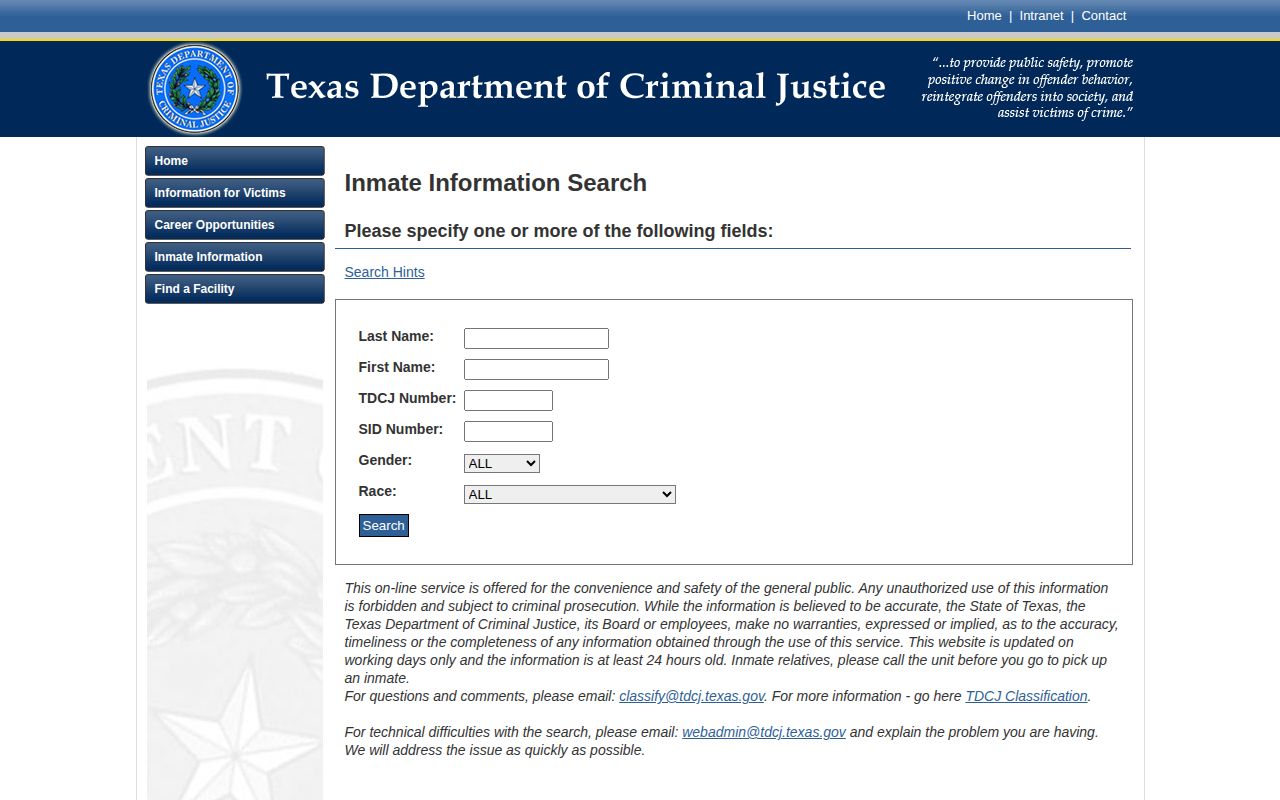
The official TDCJ search accepts a name, TDCJ number, or SID number. Search-result fields can include name, TDCJ number, race, gender, projected release date, unit, and age. Detail fields can include SID number, maximum sentence date, current facility, parole eligibility date, and special information for a scheduled release. Those are current-custody fields.
The manifest image shows the official TDCJ inmate search form used for that current lookup.
Once release has occurred, use TDCJ’s historical offender-information channel. A purpose-neutral email request can include the full name, seven-digit TDCJ number, or exact date of birth or approximate age and conviction county when the number is unknown. Ask for incarceration history and actual release or discharge date and type.
For county custody, obtain the sheriff’s release event. For state notification, use the current TDCJ IVSS. The Rains County VINELink release check explains why Texas county IVSS and TDCJ IVSS are separate and why alerts still need agency confirmation.
Rains County Parole Eligibility Dates
Parole eligibility is an earliest review point under the applicable sentence calculation. It is not a promise of review on a public hearing calendar and not a release order. Texas ordinary parole review is a file-review and voting process. Board staff identify cases before the review point, prepare a case summary, and submit the file to a panel.
Decision codes can approve release when eligible, set a future month, attach program or transfer conditions, schedule a later review, or deny release. Approval can be withdrawn when new information arrives. The release plan also must be processed. Read the Board outcome and the later TDCJ custody event as two separate records.
- Parole eligibility date
- The earliest review point calculated under the applicable law.
- Projected release date
- A current TDCJ administrative projection, subject to change.
- Maximum sentence date
- The calculated sentence endpoint shown by TDCJ.
- Actual release date
- The retrospective date on the agency’s completed release event.
Note: Direct discharge ends the state sentence without Parole Division supervision, while parole and mandatory supervision continue legal custody in the community.
Rains County Jail Credit Requests
Rains County’s Justice of the Peace page publishes a “Rains County Jail Credit Request” among its criminal-citation forms. That is a narrow local record. It may document a request to apply confinement credit toward a justice-court obligation. It is not a jail release certificate and does not show where the person went.
Use the form only with the signed court action and sheriff custody event. For a sentence calculation, gather every judgment, check the credited time, identify whether sentences run at once or in sequence, and compare those facts with the custodian’s sheet. No Rains County-specific public weekend-release or local good-time policy was located, so no Friday-release rule should be imported from another place.
The official Rains County Justice Court page supplies the local form context. Questions about a TDCJ calculation still belong with state Classification and Records, while questions about a Rains County jail event belong with the sheriff.
Resolve Conflicting Rains Release Dates
When a judgment, jail-credit figure, Board notice, and TDCJ detail page disagree, preserve each dated record. Confirm that every sentence and cumulation order was transmitted, that the offense date and governing statute match, and that all county jail credit was posted. TDCJ Classification and Records should resolve the official state calculation. A private sentence calculator cannot settle the conflict.
New credit, a corrected judgment, disciplinary forfeiture, an additional sentence, escape time, a detainer, or Board action can change the displayed projection. Even a favorable parole vote may carry a program, transfer, or release-plan condition. The scheduled field should therefore be read as the latest agency snapshot, not a promise of transportation or a gate hour.
For a county sentence, request the sheriff's time-calculation sheet and release event, then compare both with the signed judgment. Rains County publishes no special weekend-release or local good-time rule. The Justice Court's jail-credit request form concerns credit toward a court obligation; it is not a release certificate and does not identify where a person went.